Thursday, November 28, 2019

Guiding and learning tools for children and for everyone
One of the best and easy coding & learning tool
A place to know Geometry and Algebra at its best
A TedTalk a day, a watch it to shine it
BBC Bitsize
Youtube channels
Mathantics
Numberphile
Thursday, November 21, 2019
AI for For the Blind and Visually Impaired
I'm not sure if there is any device or product around that just replaces human eye with digital smart camera. What I mean is Smart Eye Device can do?
Wearable Smart Eye Device WSED Features:
Wearable Smart Eye Device WSED Features:
- Identity obstacles , identify people around while walking.
- Look for traffic light any object to assist visually challenged person to move around with ease like normal eye can. Assistive and adaptive vision to make a clear mapping of path for visually challenged. 360 eye vision smart device for safety.
- Read image, text and recognize any people and object. Just like any eye.
Just imagine if automated car can manoeuvre then on similar line we can think of solution to replace eye with smart eye.
This product is one step forward to achieve one of the above functions what if AI revolutionized and does wonder.
Not sure if Microsoft HOLO lens 2.0 or vitual reality to Actual reality
Wednesday, November 20, 2019

Monday, November 18, 2019
My Xamarin Journey So far
Xamarin.forms
Controls-Component
Explore AdMob
- MVVM
- Data Binding
- Resource
- MainActivity - Icon
- Splash Screen On load launcher
- ResourceDictionary
- Dynamic vs static Resource
- Frame
- Use of Application setting
Controls-Component
- Listview/Collection View
- Tab View
- Carousal
- Grid View
- TabbedPage
Explore AdMob
Thursday, November 14, 2019

Thursday, October 31, 2019
Math: Pascal Triangle unknown facts and mysteries
This may look like a neatly
arranged stack of numbers, but it's actually a mathematical treasure trove.
Indian mathematicians called it the Staircase of Mount Meru. In Iran, it's the
Khayyam Triangle. And in China, it's Yang Hui's Triangle. To much of the
Western world, it's known as Pascal's Triangle after French mathematician
Blaise Pascal, which seems a bit unfair since he was clearly late to the party,
but he still had a lot to contribute. So what is it about this that has so
intrigued mathematicians the world over? In short, it's full of patterns and
secrets.
First and foremost, there's the pattern that generates it. Start with
one and imagine invisible zeros on either side of it. Add them together in
pairs, and you'll generate the next row. Now, do that again and again. Keep
going and you'll wind up with something like this, though really Pascal's
Triangle goes on infinitely. Now, each row corresponds to what's called the
coefficients of a binomial expansion of the form (x+y)^n, where n is the number
of the row, and we start counting from zero. So if you make n=2 and expand it,
you get (x^2) + 2xy + (y^2). The coefficients, or numbers in front of the
variables, are the same as the numbers in that row of Pascal's Triangle. You'll
see the same thing with n=3, which expands to this. So the triangle is a quick
and easy way to look up all of these coefficients. But there's much more. For
example, add up the numbers in each row, and you'll get successive powers of
two. Or in a given row, treat each number as part of a decimal expansion. In
other words, row two is (1x1) + (2x10) + (1x100). You get 121, which is 11^2.
And take a look at what happens when you do the same thing to row six. It adds
up to 1,771,561, which is 11^6, and so on. There are also geometric
applications. Look at the diagonals. The first two aren't very interesting: all
ones, and then the positive integers, also known as natural numbers. But the
numbers in the next diagonal are called the triangular numbers because if you
take that many dots, you can stack them into equilateral triangles. The next
diagonal has the tetrahedral numbers because similarly, you can stack that many
spheres into tetrahedra. Or how about this: shade in all of the odd numbers. It
doesn't look like much when the triangle's small, but if you add thousands of
rows, you get a fractal known as Sierpinski's Triangle. This triangle isn't
just a mathematical work of art. It's also quite useful, especially when it
comes to probability and calculations in the domain of combinatorics.
Say you
want to have five children, and would like to know the probability of having
your dream family of three girls and two boys. In the binomial expansion, that
corresponds to girl plus boy to the fifth power. So we look at the row five,
where the first number corresponds to five girls, and the last corresponds to
five boys. The third number is what we're looking for. Ten out of the sum of
all the possibilities in the row. so 10/32, or 31.25%. Or, if you're randomly
picking a five-player basketball team out of a group of twelve friends, how
many possible groups of five are there?
In combinatoric terms, this problem
would be phrased as twelve choose five, and could be calculated with this
formula, or you could just look at the sixth element of row twelve on the
triangle and get your answer. The patterns in Pascal's Triangle are a testament
to the elegantly interwoven fabric of mathematics. And it's still revealing
fresh secrets to this day. For example, mathematicians recently discovered a
way to expand it to these kinds of polynomials. What might we find next? Well,
that's up to you.
Friday, October 18, 2019
Geogera: Algorithm Bezier Curve Steps
- Bezier Curve
1 Point A
2 Point B
3 Segment a Segment [A, B]
4 Point C
5 Segment b Segment [A, C]
6 Number n
7 List listAB Sequence[A + i / n (B - A), i, 1, n]
8 List listAC Sequence[A + i / n (C - A), i, 1, n]
9 List list3 Sequence[Segment[Element[listAB, i], Element[listAC, n - i]], i, 1, n]
10 List listBC Sequence[C + i / n (B - C), i, 1, n]
11 List list5 Sequence[Segment[Element[listAB, i], Element[listBC, n - i]], i, 1, n]
12 Segment c Segment [C, B]
13 List listCB Sequence[B + i / n (C - B), i, 1, n]
14 List list6 Sequence[Segment[Element[listAC, i], Element[listCB, n - i]], i, 1, n]
Geogebra: Divide Cirlce with n parts with polar view
https://www.geogebra.org/graphing/qz9nvmbp
Divide Circle with n parts
Sequence(Rotate(B, i°, A), i, 0, 360, 360 / n)
Join segments from Center A to n points on circle circumference
Sequence(Segment(A, l1(n)), n, 0, 100)

Wednesday, October 16, 2019
Coding Standards, Guidelines and Best Practices: Avoid Aysnc Void
Getting Started with Asynchronous Programming in .NET

Use Async Void
protected async void search_click( object sender, RouteEventArgs e)
Async Void is only appropriate for Event Handler
{
await GetStocks()
}
Alternate Solution
private async Task GetStock()
{
}
Take Away:
Async Void crashes an application or may results in 500 exception if something went wrong. As there is no way to propagate exception even you have proper try catch.
Call GetStock()
private async void GetStock()
{
try
{}
catch()
}
Take Away:
Async Void crashes an application or may results in 500 exception if something went wrong. As there is no way to propagate exception even you have proper try catch.
Call GetStock()
private async void GetStock()
{
try
{}
catch()
}
Monday, October 14, 2019
Geogebra: Circle with Sequence, Dilate and Segment geometry tricks
Learn Geometry
You can open my geogebra activity and can try similar activity.
Click here
Hint:
Sequence(Dilate(C, i / s, B), i, 1, s)
To divide segment into equal parts with dynamic points in it
Sequence(Segment(G, l5(n)), n, 0, s)
To create dynamic segments

It makes lot of sense when you.....
It makes lot of sense when you're SEEN, HEARD and VALUED! If that is the case then you're actually part of it or you're acknowledged or you've been respected Otherwise that is not the place you should be.
Just imagine you're in a meeting or discussion, you're seen but not heard if heard not valued that means you're not required.
Now in this case you're part of the team and you're seen but heard perhaps not valued . Your opinion doesn't stands any good. In and all it is very important you should be seen , heard and at the same time valued. That means you're respected and people needs you.
So bottom line is, the only way you should feel you're R equired or C onnected or R espected, it is only through these sense of acknowledgment of being Seen, heard and valued .
Eventually it shapes your whole career path for Being what you're, Belong to place you want to be and Become is the path to your career progression ...you want to be.
If none of these happens then it is a call for ....?
Thursday, October 3, 2019
Monday, September 23, 2019
.Net core http pipeline processing Use, Run or Map
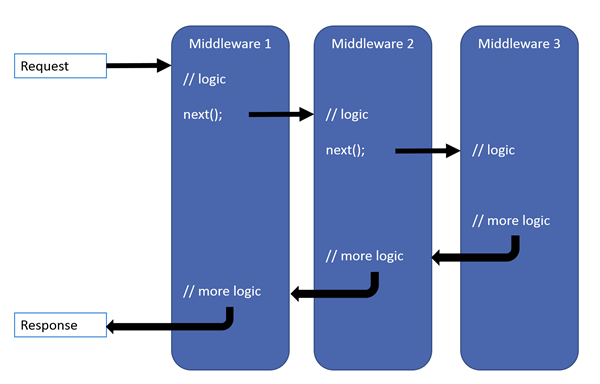
public void Configure(IApplicationBuilder app, IWebHostEnvironment env) { if (env.IsDevelopment()) { app.UseDeveloperExceptionPage(); app.UseDatabaseErrorPage(); } else { app.UseExceptionHandler("/Error"); app.UseHsts(); } app.UseHttpsRedirection(); app.UseStaticFiles(); app.UseCookiePolicy(); app.UseRouting(); app.UseAuthentication(); app.UseAuthorization(); app.UseSession(); app.UseEndpoints(endpoints => { endpoints.MapRazorPages(); }); }
public void Configure(IApplicationBuilder app) { app.Map("/map1/seg1", HandleMultiSeg); app.Run(async context => { await context.Response.WriteAsync("Hello from non-Map delegate."); }); }
Dependency Injection Overview
Highlevel
- Register Services(Collection) in container
- Define Object lifetime- Transient| Scoped|Singleton
- Create Instance at run time

Transient
Create instance of an object everytime it is requestedScoped
Create object and lifetime of an object stays as scope definedSingleton
Created once for an application level and served single object for all request.Monday, September 16, 2019
Solr Value cannot be null. Parameter name: fieldNameTranslator
Problem
Server Error in '/' Application.
Value cannot be null.
Description: An unhandled exception occurred during the execution of the current web request. Please review the stack trace for more information about the error and where it originated in the code.
Exception Details: System.ArgumentNullException: Value cannot be null.
Parameter name: fieldNameTranslator
Source Error:
Stack Trace:
Temporary Solution
Go to sitecore.contentsearch
EnableSearch=false
Server Error in '/' Application.
Value cannot be null.
Parameter name: fieldNameTranslator
Description: An unhandled exception occurred during the execution of the current web request. Please review the stack trace for more information about the error and where it originated in the code.Exception Details: System.ArgumentNullException: Value cannot be null.
Parameter name: fieldNameTranslator
Source Error:
An unhandled exception was generated during the execution of the current web request. Information regarding the origin and location of the exception can be identified using the exception stack trace below. |
Stack Trace:
|
Bit of a hack!
Temporary Solution
Go to sitecore.contentsearch
EnableSearch=false
Tuesday, September 10, 2019
Types of Cryptograph Algorithms
- Symmetry
- Asymmetry
- Hash function
Symmetry Cryptograph
E.g One time pad/ Caeser Cipher /Enigma Machine they have same key to encrypt and decrypt
Asymmetry Cryptograph
E.g One time pad/ Caeser Cipher /Enigma Machine they have same key to encrypt and decrypt
Encryption and decryption should follow this mechanism
- Confusion- Message and Key
- Diffusion- Message and Cipher Text
Data Encryption Standard: DES vs AES: Advanced Encryption Standard
AES 256
Provides confusion
Cipher Block Chaining
Provide Diffusion
Classes Of Cryptographic Hash Functions
There are several different classes of hash functions. Here are some of the most commonly used:
- Secure Hashing Algorithm (SHA-2 and SHA-3)
- RACE Integrity Primitives Evaluation Message Digest (RIPEMD)
- Message Digest Algorithm 5 (MD5)
- BLAKE2
An Intro To One-Way Hash Functions
Hash functions are often called one-way functions because, according to the properties listed above, they must not be reversible. If an attacker could easily reverse a hash function, it would be totally useless. Therefore, cryptography requires one-way hash functions.
The best way to demonstrate a one-way function is with a simple modular function, also called modular arithmetic or clock arithmetic. Modular functions are mathematical functions that, put simply, produce the remainder of a division problem.
So, for example, 10 mod 3 = 1. This is true because 10 divided by 3 is 3 with a remainder of 1. We ignore the number of times 3 goes into 10 (which is 3 in this case) and the only output is the remainder: 1.
Let’s use the equation X mod 5 = Y as our function. Here’s a table to help get the point across:

You can probably spot the pattern. There are only five possible outputs for this function. They rotate in this order to infinity.
This is significant because both the hash function and the output can be made public but no one will ever be able to learn your input. As long as you keep the number you chose to use as X a secret, it’s impossible for an attacker to figure it out.
Let’s say that your input is 27. This gives an output of 2. Now, imagine that you announce to the world that you’re using the hash function X mod 5 = Y and that your personal output is 2. Would anyone be able to guess your input?
Obviously not. There are literally an infinite number of possible inputs that you could have used to get a result of 2. For instance, your number could be 7, 52, 3492, or 23390787. Or, it could be any of the other infinite number of possible inputs.
The important point to understand here is that one-way hash functions are just that: one-way. They cannot be reversed.
When these same principles are applied to a much more sophisticated hash function, and much, much bigger numbers, it becomes impossible to determine the inputs. This is what makes a cryptographic hash function so secure and useful.
Regardless of the length of the input, the output will always be the same fixed length and it will always appear completely random. Play around with this tool to see for yourself.
SHA256 Hash of your string:
Custom Iterators
Custom Iterators
By Bill Wagner
In this article, I’ll discuss custom
iterators, predicates, and generic methods. You can combine these three
techniques to create small building blocks that plug together in a variety of
ways to solve everyday development problems.
Once you can recognize when to apply this pattern, you will be able to create
a large number of reusable building blocks.
When we build software, we rarely work with
one instance of a data type. Instead,
most of our work centers on collections of data: Lists, Arrays, Dictionaries, or other collections. As
a result, so much of our code appears in a series of loops:
foreach ( Thing a in someContainer)
doWorkWith(a);
That’s simple enough, and there’s little
point in trying to get more reuse from that simple construct. But most of our daily work isn’t really that
simple. Sometimes the iteration creates a new collection, or a new sequence.
Sometimes the iteration should only affect some of the elements in a
collection, not all them. Sometimes the iteration will remove some elements
from the collection. With all the
different variations, we’re back to copying code and modifying it. That lowers our productivity. When you create
custom iterators and predicates instead of copying and modifying loops, you
decouple the common actions from the specific code. And, often, you will use
the output from one iteration as the input to another. By using custom iterators to perform the
iteration, you can save memory and increase performance as well.
Let’s start with a simple sample, and
modify that code to create a set of reusable custom iterators and predicates.
Suppose you’ve been asked to print out a list of people you know from the New
York City phone book. It is a contrived problem, but it exhibits the characteristics
of many real-world problems. You need to process a large number of objects (the
list of all entries in the New York City phonebook). You need to extract a
subset of the properties of each object (the first and last names). Finally,
you need to filter the input set to generate the output set (only the people
you know). Your first attempt might look
like this:
// First attempt:
public List PeopleIKnowInNewYork()
{
IEnumerable
newYorkNumbers =
PhoneBook.FindListFor(“New York”);
List
peopleIKnow = new List();
foreach
( PhoneBookEntry ph in newYorkNumbers)
{
string name = string.Format(“{0} {1}”, ph.FirstName, ph.LastName);
if ( RecognizePerson( name ) )
peopleIKnow.Add(name);
}
return
peopleIKnow;
}
This code does produce the proper output,
but there’s a lot to criticize. You’ve loaded every name in the New York phone
book into one list. That’s very
wasteful. Chances are you know a very small percentage of people in New York.
It is a big place, after all. However,
by creating a local List of all the
people in New York, you prevent the garbage collector from freeing any of those
entries until the entire list is processed.
At best, that’s very wasteful. If you don’t require a very large memory configuration,
your application probably fails. Also, from a design standpoint, it falls short
of expectations. Chances are that as
this imaginary sample application grows, you will get other requests for similar,
but not identical, features. For example, you may be asked to find everyone you
called in the last six months, and print out the phone number you dialed. Right
now, that produces another method that has almost the exact same contents, with
one or two changes.
As a first step to creating more usable
code, you can create a custom iterator that returns a sequence of names from a
sequence of PhoneBookEntries. That would
look like this:
IEnumerable
ConvertToNames(IEnumerable list)
{
foreach ( PhoneBookEntry entry in list)
yield return string.Format(“{0} {1}”, entry.FirstName, entry.LastName);
}
This additional method changes your
PeopleIKnow method to this:
// Second attempt:
public List PeopleIKnowInNewYork()
{
IEnumerable
newYorkNumbers =
PhoneBook.FindListFor(“New York”);
List peopleIKnow = new List();
foreach ( string name in CovertToNames(newYorkNumbers))
{
if
( RecognizePerson( name ) )
peopleIKnow.Add(name);
}
return
peopleIKnow;
}
It’s a little better. Now, anytime you get
a new request that requires you to convert a set of phone entries to a set of
strings, you’ve already got the method to do it. One more quick modification to
the method saves you a lot of memory. If
you examine the application, you’ll almost certainly find that you never need
the full list of names. You really only need to enumerate the list of
names. So, you can try this modification
and see if everything still compiles:
public IEnumerable
PeopleIKnowInNewYork()
That works, so you can change the PeopleIKnowInNewYork method to a custom
enumerator method:
// Third attempt:
public IEnumerable
PeopleIKnowInNewYork()
{
IEnumerable newYorkNumbers =
PhoneBook.FindListFor(“New York”);
foreach ( string name in ConvertToNames(newYorkNumbers))
{
if
( RecognizePerson( name ) )
yield return name;
}
}
Let’s stop a minute and consider what you’ve
accomplished, and how you can use these techniques in other use cases and other
applications. For this discussion, let’s
assume you’ve changed PhoneBook.FindListFor()
to be an enumerator method as well.
You started with a pipeline that looked like
this:
- Create a list of every phone book entry in the New York
phonebook
- Examine every entry in that list
- Create name from the phone book entry
- If the name is recognized, add it to the output list
By changing methods to enumerators, you’ve
created a pipeline that looks like this:
- Read an entry from the phone book.
- Create a name for that entry
- If the name is recognized, return the name
- repeat
That’s a good start. This set of changes took away much of the
memory pressure that this method placed on the system. There may only be one PhoneBookEntry and one string
representation of a name in memory at one time. Any PhoneBookEntry objects already processed are eligible for garbage
collection.
You can do better by introducing
predicates, in the form of .NET delegates. The code you created is a little bit
more reusable, but still suffers from being very specific to the operation at
hand: finding recognized names from the
New York Phone book. In order to make
this code more reusable, you need to parameterize that specific portion of the
algorithm. The problem, though, is that the specific portion of the algorithm
is actually code. Luckily, the .NET
Framework and C# have a way to introduce code as a parameter to a method: a
delegate.
Start with your ConvertToNames method. With that as a base, you can build what we
want: a method that transforms an input sequence into an output sequence of a
different type. Here is the ConvertToNames method:
IEnumerable
ConvertToNames(IEnumerable list)
{
foreach ( PhoneBookEntry entry in list)
yield return string.Format(“{0} {1}”, entry.FirstName, entry.LastName);
}
What you want is to pass the code
‘string.Format(…)” as a parameter to the method. So you change the signature of
ConvertToNames like this:
// A generic method to transform one sequence
into another:
delegate Tout Action(Tin
element);
IEnumerable Transform(IEnumerable list, Action method)
{
foreach( Tin entry in list)
yield return method(entry);
}
This has some new syntax, but it’s really
fairly simple. The delegate definition
defines the signature of any method that takes one input parameter and returns
a single object of another type. Transform simple defines a pipeline that
returns the output of the delegate for every object in the input sequence. It’s
the same thing as ConvertToName, but it can be used for any input type, any
output type, and any algorithm that transforms one type into another.
You’d call that method like this:
// Fourth attempt:
public IEnumerable
PeopleIKnowInNewYork()
{
IEnumerable newYorkNumbers =
PhoneBook.FindListFor(“New York”);
foreach ( string name in Transform(newYorkNumbers,
delegate(PhoneEntry entry)
{
return string.Format(“{0} {1}”, entry.FirstName, entry.LastName);
}))
{
if
( RecognizePerson( name ) )
yield return name;
}
}
There are a few new concepts here, so let’s
go over it in detail. This code is a little easier to understand if you change
the structure just a bit. So here’s the
fifth version:
// Fifth attempt:
public IEnumerable
PeopleIKnowInNewYork()
{
IEnumerable newYorkNumbers =
PhoneBook.FindListFor(“New York”);
IEnumerable names = Transform(newYorkNumbers,
delegate(PhoneEntry entry)
{
return string.Format(“{0} {1}”, entry.FirstName, entry.LastName);
});
foreach (string name in names)
{
if
( RecognizePerson( name ) )
yield return name;
}
}
The expression defining names defines a new
enumeration over all the names harvested from the phone book. It defines the delegate method inline, making
use of anonymous delegates. Note that
I’m only creating a single line delegate here. I’d recommend against creating
complicated methods as anonymous delegates. But, when you need to wrap an
existing function call in a delegate, this syntax is much simpler for other
developers to follow.
There’s one last loop to convert to
something more generic: The loop that
checks for names you know. This one can be refactored into a well-known generic
pattern:
delegate bool Predicate(T inputValue);
IEnumerable
Filter(IEnumerable list, Predicate condition)
{
foreach (T item in list)
if
(condition(item))
yield return item;
}
You should recognize this pattern by now.
The Filter is just a pipeline that returns all members of a list that match the
condition specified by the predicate.
One last look at that PeopleIKnowInNewYork method shows how you can use
it:
// Fifth attempt:
public IEnumerable
PeopleIKnowInNewYork()
{
IEnumerable newYorkNumbers =
PhoneBook.FindListFor(“New York”);
IEnumerable names = Transform(newYorkNumbers,
delegate(PhoneEntry entry)
{
return string.Format(“{0} {1}”, entry.FirstName, entry.LastName);
});
return
Filter(names, delegate(string name)
{
return RecognizePerson(name);} );
}
The final version is quite a bit different
than what you started with, and some may argue that it’s not that
different. But it depends on how you
apply it. The final version is structured around much more powerful building
blocks. You built a generic method that
filters a list of any type, as long as you supply the specific condition for a
single item. You built a generic method that transforms a sequence of one type
into a sequence of another type. You can leverage this same technique for other
operations. This method samples an input
sequence, returning every Nth item:
IEnumerable
NthItem(IEnumerable input, int sampleRate)
{
int
sample = 0;
foreach (T aSample in input)
{
++sample;
if
(sample % sampleRate == 0)
yield return aSample;
}
}
This method generates a sequence, based on
some factory method you define:
delegate T Generator();
IEnumerable Generate(int
number, Generator factory)
{
for
(int i = 0; i < number; i++)
yield return factory();
}
And this method merges two sequences of the
same type into a new type combining them:
delegate Tout MergeOne(Tin a,
Tin b);
IEnumerable Merge(IEnumerable first,
IEnumerable second, MergeOne factory)
{
IEnumerator firstIter = first.GetEnumerator();
IEnumerator secondIter = second.GetEnumerator();
while
(firstIter.MoveNext() && secondIter.MoveNext())
yield return factory(firstIter.Current, secondIter.Current);
}
By separating the actions on a single
object from the actions on a sequence of types, you created a set of more
powerful building blocks to work with very large sets of sophisticated data
types.
Summary
In this article, I showed you how custom
iterators, delegates, and generic methods can be combined to create more
powerful reusable building blocks for your applications. By applying these techniques yourself, you’ll
find many uses for these techniques, and you’ll be more ready for C# 3.0, where
many of these techniques enjoy more embedded language support.
Monday, September 9, 2019
Cryptography Funcdamentals- One Time Pad vs Caesar Cipher
Encryption/ Decryption
Encipher/Decipher
Shift any number of space to shuffle the alphabet
Encipher/Decipher
Improvement on Caesar Cipher
Shift any number of space to shuffle the alphabet
One Time Pad
I recently saw The Spy Netflix by Sacha Baron
It used Morse code. The topic is different but it shows in olden days how things were transmitted.
Subscribe to:
Posts
(
Atom
)